P0420 Code on Fleet Vehicles: Diagnosis, Costs & Impact
TL;DR 4 key takeaways Definition: The P0420 code indicates that the catalyst on bank 1 of a vehicle is operating below the efficiency threshold,...

GOOGLE CLOUD NEXT 2026 RECAP , FLEET INTELLIGENCE SERIES PART 2 of 5
In part one of this series, I made a simple argument: the pilot era for AI in fleet management is over. The infrastructure is production-ready, the costs have dropped, and the companies that move now will build an advantage that late adopters cannot easily close.
But there is a prerequisite that no AI vendor wants to talk about, because it is not glamorous and it does not fit on a slide deck. Before you can benefit from any of the AI capabilities announced at Google Cloud Next 2026, you need to solve the data problem. And in our industry, the data problem is not that we lack data. It is that our data is scattered, siloed, inconsistent, and often invisible to the systems that need it most.
This article is about why your data, not your AI, is your real competitive moat, and what the infrastructure announced last week means for fleet companies serious about building one.
Every fleet I work with pays a hidden tax I call the fragmentation tax. It is the cost of operating with disconnected data, not in software licenses, but in the hours your operations team spends manually reconciling information that should flow automatically.
Your operations team lives in a TMS to manage loads and shipments, a telematics and ELD platform for vehicle tracking and compliance, a maintenance management system for work orders and parts, and a routing solution for dispatch and navigation. Each one works. But they barely talk to each other. Your dispatcher cannot see real-time maintenance status when assigning a load. Your safety manager reviews dashcam events in one platform, then manually cross-references them with driver training records in another. Your accountant reconciles fuel receipts against routes using a spreadsheet that nobody trusts entirely. The data exists, it just lives in four or five separate applications with limited or no capacity to exchange data and insights between one another.
This is not a technology problem in the traditional sense. Each of those individual systems works. The problem is the white space between them, the gaps where information falls, where context is lost, where humans become the integration layer because the machines cannot talk to each other.
Now multiply that tax by every truck, every driver, every route, every week. For a mid-size fleet, the fragmentation tax is measured in tens of thousands of dollars annually. For large operations, it is measured in millions. And it is almost entirely invisible, because it has been embedded in how the industry operates for so long that most people accept it as the cost of doing business.
The fragmentation tax is not a line item on your P&L. It is buried in every wasted hour your team spends switching between systems, re-entering data, and reconciling reports that should reconcile themselves.
.png?width=397&height=374&name=_-%20visual%20selection%20(2).png)
The most consequential announcements at Cloud Next had nothing to do with AI agents, chatbots, or automation. They were about data infrastructure, the plumbing that makes everything else work.
Three capabilities stood out to me as directly relevant to fleet operations:
First, the concept of a knowledge catalog that understands what your data means, not just where it lives. Think of it as a librarian for your fleet data. Today, if someone asks "what is our average fuel cost per mile for Class 8 vehicles on cross-border routes?", answering that question requires pulling from at least three systems and hoping the definitions match. A knowledge catalog standardizes those definitions, maps the relationships, and makes that question answerable instantly, by a human or by an AI agent.
Second, the ability to unify data across different storage systems without moving it. This is critical for our industry, because fleet data lives everywhere, telematics providers, TMS platforms, ERP systems, compliance platforms, third-party fuel networks. The traditional approach was to build a data warehouse and copy everything into it. The new approach is to leave the data where it is and build a logical layer that reads across all of it. Less cost, less complexity, less risk of the data being stale by the time it arrives.
Third, and this one has immediate practical implications, intelligent document processing at scale. Fleet operations run on documents: bills of lading, proof of delivery, inspection reports, customs declarations, maintenance work orders, fuel receipts. Most of these are still processed manually or semi-manually. The document intelligence capabilities I saw can extract structured data from unstructured documents, classify them, validate them against your existing records, and route them to the right system, all without a human touching them unless something is flagged as anomalous.
This is an area where we are already moving. AttriX GoRoute does not just handle navigation and driver workflow, it performs document scanning with multi-layer AI-powered OCR that extracts bill of lading content at the point of capture. That extracted data transfers directly to TMS platforms for instant invoicing, eliminating the days-long lag that most carriers still accept as normal. But what excites me most is what comes next: our conversational AI tools allow managers and drivers to have interactive conversations about each scanned document and BOL, asking questions, verifying details, flagging discrepancies, in natural language. The document becomes a living data source, not a static image in a filing system. The infrastructure announced at Cloud Next will make this kind of intelligent document pipeline available to the entire industry. We are already building it.
This is where I have to be direct, because it touches something I have spent years building and something I believe the industry gets fundamentally wrong.
Most ELD, TMS and MMS platforms offer some version of built-in analytics, native dashboards, canned reports, even AI-powered add-ins that promise to surface insights automatically. And for a generic overview, they work well enough. But here is the problem: they apply generic filters, generic data structures, and generic benchmarks to an industry where no two operations are the same.
I have been in this industry for twenty-five years, and I have never met two fleets that work and operate exactly the same. Every fleet has their own secret sauce, their own routing logic, their own driver management philosophy, their own maintenance cadence, their own definition of what "good" looks like. And it works. The question is whether your data platform respects that reality or ignores it.
At AttriX, we built Lighthouse BI, our business intelligence platform, running on enterprise cloud infrastructure, for exactly this reason. Not to replace the analytics that come with your telematics provider, but to go beyond them. To build a data environment where fleet intelligence is governed, cleaned, structured, and made trustworthy through something that no algorithm alone can provide: domain-specific human expertise.
What does that mean in practice? It means our team, people who have spent their careers in fleet operations, maintenance, compliance, and transportation finance, work directly with the data before it ever reaches a dashboard or an AI model. They understand that a fuel outlier for a refrigerated long-haul carrier is not the same as a fuel outlier for a regional construction fleet. They know that hours-of-service patterns for a team-driving cross-border operation tell a completely different story than HOS data from a local day-cab operation. They recognize that a maintenance cost spike in winter for a fleet running the 401 corridor is normal, while the same spike for a fleet operating in the Southeastern US is a red flag.
This is not work that an automated filter can replicate. It requires experience, judgment, and an intimate understanding of how fleets actually run, not how a software platform assumes they run.
We clean the data. We remove the outliers that would mislead any analytics system. We structure it according to each fleet's actual operational reality, their vocations, their routes, their seasonal patterns, their specific KPIs. And we ensure that when an AI agent eventually queries that data, it is working with information that is reliable, contextual, and truthful.
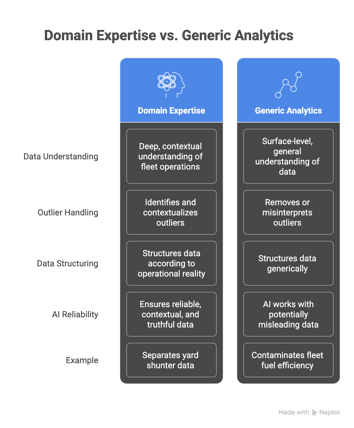 Here is a concrete example. A large hub-and-spoke carrier runs a fleet of older trucks as yard shunters, vehicles that shuttle trailers between docks and parking spots on the property. These units log almost no road mileage, but they idle constantly and consume a disproportionate amount of fuel relative to their distance traveled. If you feed that raw data into a generic analytics platform, those shunters contaminate the entire fleet's fuel efficiency numbers. Your average fuel cost per mile looks significantly worse than it actually is. Your benchmarking against industry standards becomes meaningless. And if an AI agent uses that data to recommend operational changes, it is making recommendations based on a false picture. We catch that. We contextualize those yard vehicles separately, because someone on our team understands that a shunter running eight hours a day on a yard is not the same operational profile as a Class 8 tractor running the 401. That distinction does not exist in a generic filter. It exists in domain expertise.
The data that future AI agents will rely on to make recommendations, flag risks, and drive operational decisions must be trustworthy. Not generically filtered. Not algorithmically averaged. Trustworthy, because a human who understands your operation verified it.
This is the bridge between business intelligence and AI-ready data. Solution-native BI tools give you a view of your data through the vendor's lens. Lighthouse BI gives you a view of your data through your lens, structured by people who understand that a waste hauler in Abitibi and a pharmaceutical carrier in the GTA need fundamentally different data architectures, even if they both run the same telematics hardware.
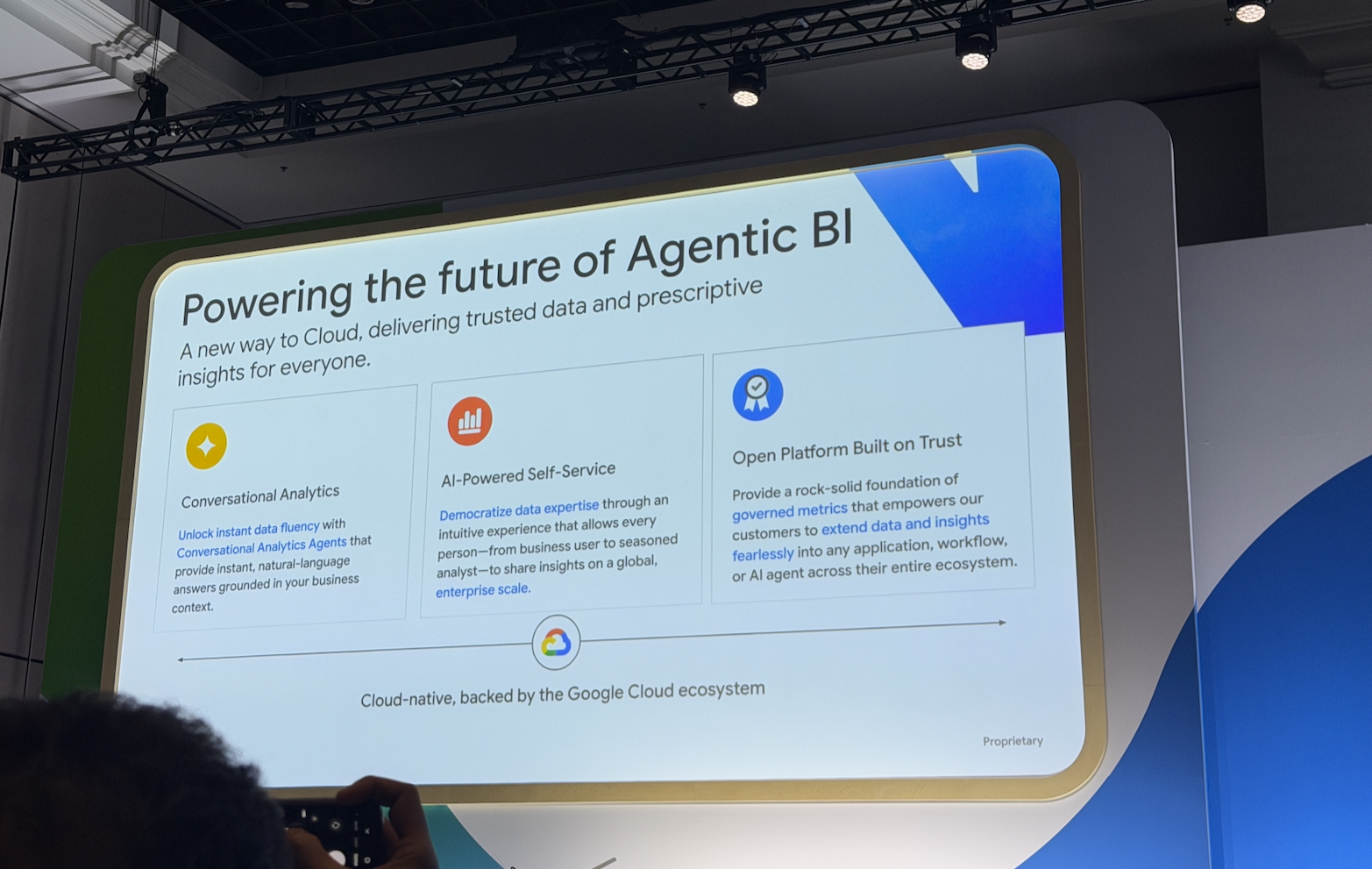
The infrastructure announced at Cloud Next validates this approach entirely. When knowledge catalogs, unified data layers, and AI agents enter the picture, the fleets that will extract the most value are the ones whose data is already governed, already structured, and already trustworthy. Not the ones scrambling to clean up years of generic dashboards the moment they want an AI agent to act on their data.
We have been building that foundation, quietly, methodically, fleet by fleet, for years. The new infrastructure does not change our direction. It accelerates it.
There is one more dimension to this conversation that fleet executives need to take seriously: governance. As AI becomes more deeply embedded in operations, the quality and trustworthiness of your data becomes a safety issue, not just an efficiency issue.
If an AI agent recommends a route adjustment based on faulty fuel data, that is an operational inconvenience. If an AI agent flags a driver for retraining based on incomplete or inaccurate performance data, that is a human resources and legal issue. If an AI system makes a compliance determination based on stale regulatory information, that is a regulatory risk.
.png?width=328&height=365&name=_-%20visual%20selection%20(1).png) The announcements at Cloud Next included robust data lineage and governance tools, the ability to trace any AI-generated insight back to its source data, understand when that data was last updated, and verify its completeness. For fleet operations, this is not an abstract enterprise concern. It is the difference between trusting your AI and hoping your AI is right.
The announcements at Cloud Next included robust data lineage and governance tools, the ability to trace any AI-generated insight back to its source data, understand when that data was last updated, and verify its completeness. For fleet operations, this is not an abstract enterprise concern. It is the difference between trusting your AI and hoping your AI is right.
Governance is not a feature you bolt on after the fact. It is a discipline you build into your data architecture from the start, and it requires people who understand both the data and the domain it represents. Technology provides the tools for lineage, traceability, and access control. Humans provide the judgment to know what the data means, whether it is complete, and whether the AI should be trusted to act on it.
If you are a fleet executive reading this and wondering where to start, here is my honest advice:
Do not start with AI. Start with your data. Map where your fleet data lives today. Identify the gaps between systems. Understand which manual processes exist only because two platforms cannot talk to each other. Quantify the time your team spends being the human integration layer.
Then invest in connecting those data sources into a platform that can serve as the foundation for everything that comes next, analytics today, AI agents tomorrow, autonomous operational workflows the year after that.
The technology to do this exists now. It is not theoretical. It is not three years away. The infrastructure I saw at Cloud Next is in production, it is available at mid-market price points, and it is designed for exactly the kind of complex, multi-source, real-time data environment that fleet operations demand.
Your data is your moat. But only if it is connected, and only if someone who understands your operation has made it trustworthy.

I'm the Founder and President of AttriX Technologies, a Quebec-based fleet technology company managing over 60,000 connected vehicles across North America. Over 25 years in transportation technology, I've built AttriX from a telematics startup into a unified platform spanning navigation, driver workflow, business intelligence, compliance, and AI-powered fleet operations , all within the Geotab ecosystem. I believe the industry's real competitive advantage lies not in isolated point solutions but in unified data architectures that turn fleet intelligence into executive decision power. This series reflects what I'm seeing on the ground: the pilot era is over, and the fleets that move to production-grade AI now will define the next decade of North American trucking.

TL;DR 4 key takeaways Definition: The P0420 code indicates that the catalyst on bank 1 of a vehicle is operating below the efficiency threshold,...

TL;DR 4 key takeaways Definition: The P0455 indicates a large leak in the EVAP system, detected by the onboard OBD2. Fleet impact: Moderate in the...
.jpg)
 Anthony Mainville: Apr 29, 2026 1:08:24 PM
AI agent platforms, the co-pilot model, and why technology should serve your people GOOGLE CLOUD NEXT 2026 RECAP , FLEET INTELLIGENCE SERIES PART 3...