P0420 Code on Fleet Vehicles: Diagnosis, Costs & Impact
TL;DR 4 key takeaways Definition: The P0420 code indicates that the catalyst on bank 1 of a vehicle is operating below the efficiency threshold,...

Most fleets believe they are compliant right up to the moment they have to prove it. Insurance is current, inspections are scheduled, drivers are licensed. Then an audit lands, or a collision does, and a gap appears between what the operation assumed it covered and what fleet regulations actually require.
That gap is rarely about rule-breaking. It is about evidence. Fleet compliance in Canada is measured by what you can produce on request, dated and complete, sometimes going back months. This guide covers what the regulations require of a commercial vehicle operator, what an auditor asks for first, and how to hold that evidence without adding paperwork to your drivers.
What is fleet compliance? It is the obligation to operate commercial vehicles within the safety, hours and record-keeping regulations that apply to your routes, and to be able to prove it on demand. Fleet vehicle compliance in Canada answers to two levels of government at once, which is what makes it harder than it looks.
Fleet compliance is not one obligation but four, and they are enforced by different authorities. Hours of service, vehicle condition, driver qualification, and the records that tie them together. A fleet can be exemplary on three of these requirements and exposed on the fourth.
The regulations are federal and provincial at once, which is where most of the confusion starts. Which set applies to a motor carrier depends on where its commercial vehicles run, not on where the company is registered.
Federally regulated carriers are those operating extra-provincially, across a provincial or international boundary. They answer to federal regulations on hours of service, vehicle standards and record-keeping.
Carriage that stays entirely inside one province falls under that province's regulations, and each one transposes the federal requirements on its own timetable. A fleet running local routes today can therefore find itself under a different regime the moment a contract takes it across a boundary. That shift is the single most common source of unexpected non-compliance, because nothing about the commercial vehicle or the driver has changed.
The National Safety Code is the common framework Canadian jurisdictions build on. It sets standards on driver qualification, hours of service, vehicle maintenance and carrier safety ratings, and each province applies those requirements through its own legislation and enforcement.
Its practical consequence for a fleet manager is a motor carrier safety rating attached to the company, fed by roadside inspections, collisions and audit results. That rating is visible to insurers and to clients, which turns fleet safety compliance from a legal question into a commercial one. A downgraded rating costs contracts before it costs fines, and it is the point where compliance and fleet risk management stop being separate files.

Hours of service (HOS) is where most enforcement effort concentrates, and where the burden of proof is heaviest. Daily driving limits, mandatory breaks, off-duty periods and cycle limits all have to be demonstrable, not merely respected. Our article on Canadian hours of service rules sets out the daily and cycle limits in detail. Driving time is the one metric a carrier cannot reconstruct after the fact without a device that recorded it.
Since the mandate took effect, federally regulated carriers must record driving time with a certified electronic logging device. Canadian hours of service regulations differ from the American ones on a point that catches many operators: electronic logging devices cannot be self-certified by their vendor. Each device must be tested by a certification body accredited by the Standards Council of Canada, then appear on the register published by Transport Canada, which is updated as devices are certified and, occasionally, decertified.
Three exemptions remain:
The third one catches fleets out most often, because it depends on a daily return rather than a distance. One route that overruns, and the driver moves into the general regime with nothing on board to document the day. Our guide to the electronic logbook exemption in Canada sets out the conditions in detail.
Scheduled inspections make it into everyone's calendar. What rarely leaves a usable trail is the daily cycle: the pre-trip check, the defect a driver reports, and above all what happened to that defect afterwards.
A vehicle inspection report that records a fault and shows no follow-up is more damaging in an audit than a fault never detected. It proves the organisation knew. The record has to close the loop: reported, assessed, repaired or deferred with justification, and signed off.
Fleet maintenance carries the same evidentiary weight, and our article on preventive maintenance for fleets covers how to build the schedule. A preventive maintenance schedule counts only if the work was performed and documented, which is why maintenance intervals tied to actual engine hours or distance hold up better in an audit than intervals set by the calendar.
Driver qualification files follow the same logic. Licences, endorsements, medical certificates and mandatory training each carry an expiry date, and the tracking usually lives in a spreadsheet nobody opens between renewals. The failure is almost never the qualification itself. It is the twelve days between an expiry and the moment someone noticed.
A fleet crossing into the United States inherits a second set of regulations, and the two do not overlap neatly.
South of the border, driving hours fall under the Federal Motor Carrier Safety Administration (FMCSA), an agency of the United States Department of Transportation (DOT). DOT fleet compliance rests on a different logic from the Canadian one, and an operator compliant in Canada is not automatically compliant under DOT rules. Electronic logging devices are self-certified by their vendors and listed accordingly, which is the opposite of the Canadian approach.
Drug and alcohol testing is the requirement Canadian transport operators most often overlook. A driver running into the United States falls under the FMCSA testing programme, including pre-employment and random testing, and the FMCSA Clearinghouse query that goes with it. The obligation follows the route, not the company's home base, which is why a single southbound contract can change what a transportation business owes.
The consequence for equipment is concrete: a device certified only in the United States has no standing in Canada. Operators running both sides need hardware that satisfies the stricter regime, not the more convenient one. The same applies to record retention, where the longer of the two applicable periods is the safe assumption.
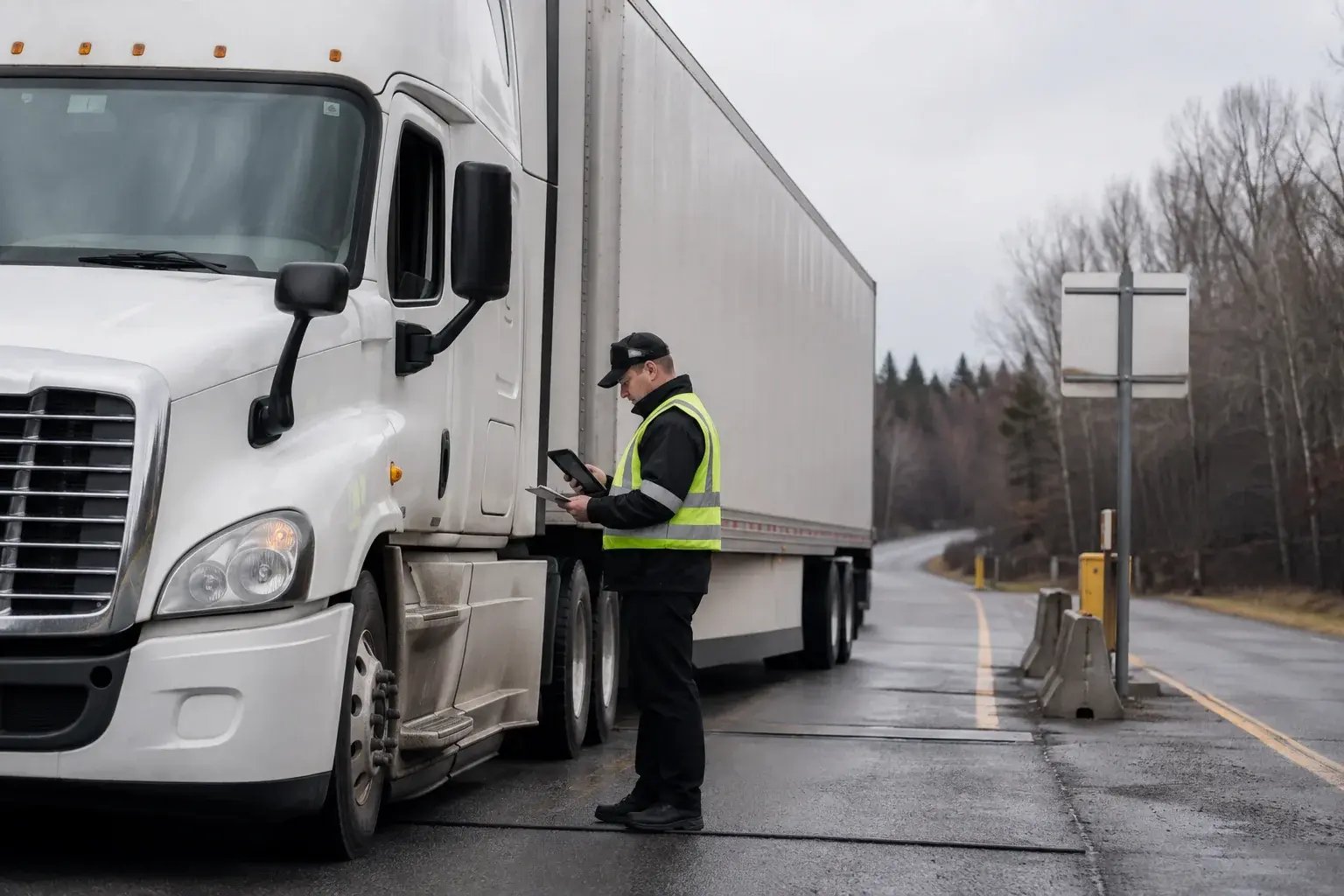
This is the part that separates a fleet that is compliant from one that can show it. An audit rarely opens with a policy question. It opens with a request for records over a defined window.
Expect four demands.
Most fleets discover at this point that their fleet compliance management data exists but does not connect. Hours sit in one system, maintenance in another, qualifications in a third. That is an architectural problem rather than a collection problem, which is good news: compliance systems solve it without changing how anyone works.
Fleet management software is judged on one criterion above its feature set: what it can produce, in what format, within how long, when someone asks. Everything else is secondary.
Most fleets combine three things:
The aim is one query instead of three systems.
Real time visibility matters less here than most demonstrations suggest. Knowing where a truck is right now serves dispatch; knowing what it did eight months ago serves the audit, and only a complete historical record does that. Compliance systems are bought on the second capability and demonstrated on the first.
Five fleet compliance services carry the regulatory weight.
Fleet compliance tracking is the thread through all five: every record has to stay attached to a vehicle and a date. A provider that covers these five in one place lets a fleet manager answer an auditor from a single record.
Training in fleet management belongs there too. The software changes what drivers and dispatchers do every day, and a compliance programme that nobody was taught to operate produces gaps that look exactly like negligence in an audit. Transport businesses that skip this step usually rebuild their records the hard way, twelve months later.
Safety and environmental reporting draw on the same vehicle data: engine hours, fuel consumption, idling, distance travelled. A platform that already captures them for fleet compliance can produce emissions reporting without new hardware, which matters as fleet operations face both regulatory and client-driven reporting on their footprint.
Three questions are worth putting to any supplier.
Fleet management in Canada has its own certification rules, its own safety code and its own retention periods, which is why a platform configured for the American market rarely fits as delivered. As Geotab's number one integrator in Canada, AttriX deploys certified devices and the fleet management solutions behind them, the compliance side included, then trains the people who will answer the auditor. Our transportation compliance services bundle these fleet compliance services: deployment, compliance training by accredited trainers, and the reporting that turns raw records into something defensible.
Speak with a compliance specialist about your current setup.
Four questions come up repeatedly from fleet managers weighing their obligations.
Fleet management rests on vehicle acquisition and lifecycle, fleet maintenance, driver management, safety and compliance, and cost control through data. Compliance is the pillar that carries legal exposure, which is why it usually drives the choice of fleet management software. The other four benefit from the same telematics data once it is captured.
Accountability sits with the motor carrier, not the driver. A fleet manager, safety officer or operations director typically holds it day to day, but regulators pursue the operating company. That is why written procedures, documented follow-up and retained records matter more than individual diligence.
A fleet is a group of vehicles operated by a single business for its commercial activity. In a regulatory context, what counts is not the number of vehicles but their weight class and use, which determine which fleet compliance requirements apply.
Retention periods vary by record type and jurisdiction, and cross-border operators are subject to both. The practical rule is to apply the longest applicable period, and to keep records queryable rather than merely stored. A commercial transport compliance review is the fastest way to establish your own requirements.
Fleet compliance costs money at two moments: when you build it, and when you have not. The second bill arrives at the worst possible time and is not negotiable. Maintaining fleet compliance is mostly a matter of capturing what already happens across your fleet operations, then being able to find it again.
Talk with an AttriX specialist to review where your compliance records stand today.

TL;DR 4 key takeaways Definition: The P0420 code indicates that the catalyst on bank 1 of a vehicle is operating below the efficiency threshold,...

TL;DR 4 key takeaways Definition: The P0455 indicates a large leak in the EVAP system, detected by the onboard OBD2. Fleet impact: Moderate in the...
.jpg)
 Anthony Mainville: Apr 29, 2026, 1:08:24 PM
AI agent platforms, the co-pilot model, and why technology should serve your people GOOGLE CLOUD NEXT 2026 RECAP , FLEET INTELLIGENCE SERIES PART 3...