P0420 Code on Fleet Vehicles: Diagnosis, Costs & Impact
TL;DR 4 key takeaways Definition: The P0420 code indicates that the catalyst on bank 1 of a vehicle is operating below the efficiency threshold,...


In trucking, roadside inspections, facility audits and collision investigations end with the same request. Show the records. Trucking company compliance in Canada depends less on knowing the rules than on proving, document by document, that drivers and vehicles followed them. This guide is written for carriers already on the road, from regional fleets to national operations. It sets out which records an inspector, an auditor or an insurer will ask for, how to keep them current, and what a lapse costs.
Trucking company compliance means running drivers and vehicles within the safety rules of every jurisdiction a carrier serves, and keeping the records that prove it. Transport Canada sets the rules for extra-provincial carriers, those that cross a provincial or international boundary. Provinces and territories regulate the rest and apply most standards on the road.
Transportation compliance starts with knowing which vehicles count, because most compliance requirements for trucking companies apply above a weight threshold. Under the federal hours of service regulations, a truck, tractor or trailer counts as a commercial vehicle once its registered gross vehicle weight exceeds 4,500 kg, a figure not to be confused with the manufacturer's gross vehicle weight rating.
| Obligation | Records to keep | Who sets the rule |
|---|---|---|
| Hours of service | Records of duty status and supporting documents, at least 6 months | Federal regulations, applied by the provinces |
| Daily trip inspection | Inspection reports, defects and repairs | NSC, provincial rules |
| Vehicle maintenance and periodic inspection | Maintenance history of each unit | NSC, provincial rules |
| Driver qualification | One file per person behind the wheel | NSC, provincial licensing |
| Safety fitness | Safety fitness certificate (extra-provincial carriers) | Federal regulations |
| Dangerous goods | Shipping documents and training certificates | TDG Act and Regulations |
An auditor can ask for every line. Trucking safety and compliance rest on that paper trail as much as on driving.

The National Safety Code (NSC) is a set of 16 minimum safety standards developed by the federal, provincial and territorial governments through the Canadian Council of Motor Transport Administrators (CCMTA). They cover the driver, the vehicle and the carrier. Each jurisdiction adopts them by reference or mirrors them in its own law, so obligations look alike across the country while forms and enforcement differ.
For a carrier, the NSC works in three steps:
1. The province where your vehicles are plated issues your NSC number.
2. A carrier safety profile records your compliance with safety regulations (Standard 7) and feeds your safety rating (Standard 14).
3. A facility audit (Standard 15) checks your level of compliance with every applicable standard.
Questions about Canada MTO compliance concern Ontario, whose Ministry of Transportation (MTO) runs the Commercial Vehicle Operator's Registration (CVOR): it tracks a carrier's collisions, convictions, inspections and audit results. Quebec carriers register instead with the RPEVL, the heavy vehicle owners and operators registry kept by the Commission des transports du Québec, which assigns a safety rating.
Carriers under federal jurisdiction also need a safety fitness certificate before they operate on Canadian highways. Talk with an AttriX specialist to map the standards that apply to your operation.
Federal rules set the following limits south of latitude 60°N. Nobody may drive after:
Each day must also include at least 10 hours off duty, 8 of them consecutive. The logs and their supporting documents stay at the carrier's principal place of business, filed chronologically for each employee.
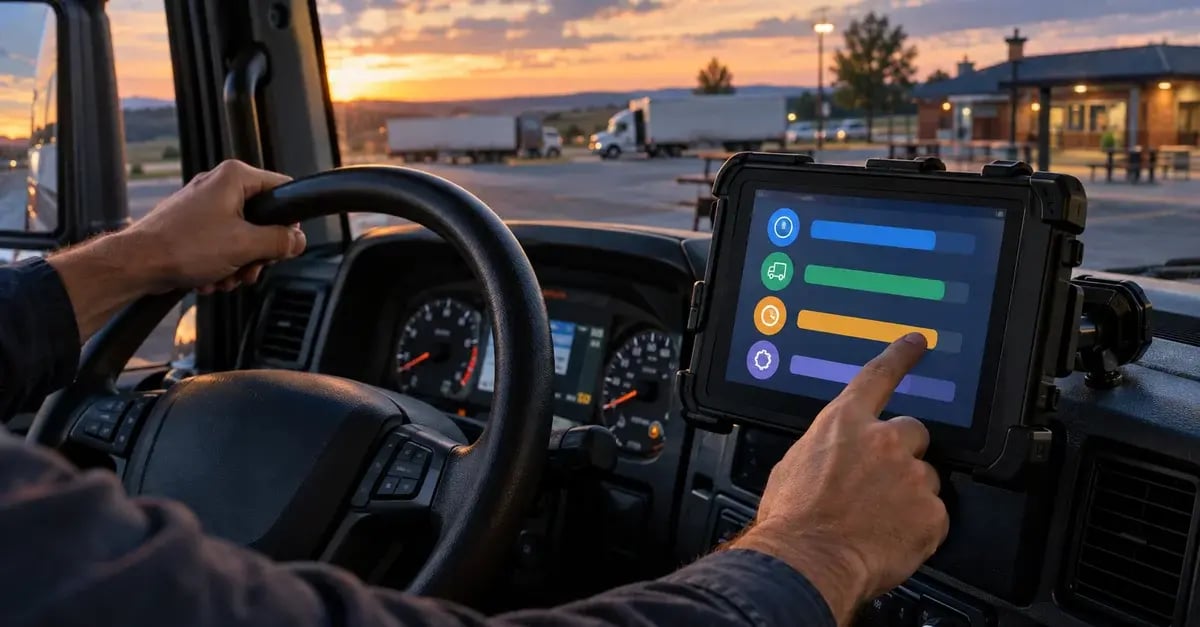
Federally regulated carriers record duty status with a certified electronic logging device. Some drivers are exempt, for example those who stay within 160 km of their home terminal and return there each day, provided the carrier keeps daily records of on-duty time. Our article on ELD exemptions in Canada lists the others.
If your fleet still needs devices, our guide to choosing a certified ELD covers what to check first.
Several National Safety Code standards concern drivers directly: one licence per person (Standard 1), licence classification (Standard 4) and driver fitness (Standard 6). The newest, published in January 2021, sets entry-level driver training for Class 1 truck licences (Standard 16).
A driver qualification file gathers this for every employee who drives: licence and class, training received, and the documents your province or insurer asks for. Keeping it current matters more than building it once. Licences expire, classes change and training certificates run out.
NSC Standard 13 requires a daily trip inspection, designed to catch defects early, protect drivers and the public, and alert carriers to mechanical problems. Standard 11 covers vehicle maintenance and periodic inspection. Standard 10 covers cargo securement.
Roadside inspectors and auditors check that these records connect, from the reported defect to the work order that fixed it.

Three obligations apply only to some carriers. Each adds its own records.
Carriers of dangerous goods fall under the Transportation of Dangerous Goods Act and Regulations. The shipping document stays within the driver's reach in the power unit, and the carrier keeps a copy for at least two years. Employees who handle the goods need a training certificate issued by their employer, valid 36 months for road transport.
Trips into the United States add US rules on top of Canadian ones, including US hours of service for the time spent south of the border. Customs programs such as FAST speed up clearance for approved companies.
Carriers that run qualified vehicles in several provinces or states file fuel tax under the International Fuel Tax Agreement (IFTA) and register under the International Registration Plan (IRP). Both split taxes or fees by the distance travelled in each jurisdiction, so distance records need to be accurate.
A safety management system (SMS) keeps trucking company compliance steady between audits, not only in the week before one. Transport Canada has studied how safety management systems apply to the trucking industry. In practice, an SMS ties trucking safety and compliance to a few habits that lower risk:
Our guide to fleet compliance explains what auditors ask for when they review these files.
When trucking company compliance slips, the risk comes in four forms: fines, vehicles or drivers placed out of service, a weaker safety rating, and lost business. Penalty amounts, including Transport Canada HOS fines, depend on the offence and on the province or territory that enforces the rule, so check its schedule rather than a national figure.
The indirect costs build up. A truck or driver placed out of service at the roadside stops the load until the problem is corrected. Every conviction and inspection result lands on the carrier safety profile. In Ontario, a rising violation rate brings a warning letter, then a likely facility audit, then a Conditional rating. Shippers, insurers and lenders can look up CVOR ratings through a public enquiry service.
AttriX turns trucking company compliance into data that updates as drivers work. Its electronic logbook, powered by Geotab, is certified and registered with Transport Canada and the FMCSA, and covers hours of service, vehicle inspection reports and driver identification.
AttriX Compliance alerts administrators as soon as a problem appears: hours of service violations, unassigned or unverified logs, use of exemptions, a truck moving without its pre-trip inspection or with a defect, or a user in the United States still assigned to Canadian rules. Administrators can correct them before a roadside inspection. Certified trainers run safety and compliance training for drivers and administrators.
As the #1 Geotab integrator in Canada, AttriX adds more than 100 features, integrations and applications developed by its own team to the Geotab platform. Our trucking compliance services page details the transportation compliance offer.
Katty Houle, of Pickup Transport, describes the result of the training: “Thanks to the training of administrators and drivers by the AttriX team, we have realized time savings.” Speak with a specialist to review your own compliance setup.
Two questions come up once the basics are in place.
No single frequency applies to every carrier. Your province decides when to audit you, based in part on your carrier profile. Electronic logs and inspection reports can be checked daily through real-time alerts, while files that change slowly, such as licences and maintenance histories, can follow a set calendar. Your provincial NSC office can tell you whether a schedule applies.
Roadside data gives a clear answer. During the CVSA 2025 International Roadcheck, held May 13 to 15 across Canada, the United States and Mexico, brake systems were the most cited vehicle out-of-service violation, ahead of tires. Among drivers, hours of service problems led, and false logs accounted for 10% of their out-of-service violations.
Trucking company compliance is easier to prove when the evidence builds itself, trip after trip. Request a demonstration to see how AttriX tracks yours.

TL;DR 4 key takeaways Definition: The P0420 code indicates that the catalyst on bank 1 of a vehicle is operating below the efficiency threshold,...

TL;DR 4 key takeaways Definition: The P0455 indicates a large leak in the EVAP system, detected by the onboard OBD2. Fleet impact: Moderate in the...

 Anthony Mainville: Apr 29, 2026, 1:08:24 PM
AI agent platforms, the co-pilot model, and why technology should serve your people GOOGLE CLOUD NEXT 2026 RECAP , FLEET INTELLIGENCE SERIES PART 3...